
October 1, 2020 – Phones were ringing in Detroit, Philadelphia and Pittsburgh, and on the line was a robocall with an ominous campaign message: If you want to vote by mail, it warned, your personal information will be turned over to the police and to debt collectors.
The call played on crude racial stereotypes and was blatantly false — but dishonesty was the point. Whoever engineered it apparently wanted to sow confusion and fear among people of color in Democratic strongholds before the Nov. 3 presidential election. Far from an aberration, UC Berkeley scholars say, the robocall was just one flashpoint in a wider campaign playing out in courtrooms, legislative chambers and political communication in battleground states and nationwide.
The objective, pursued by Republicans in a seeming war of attrition, is to use a range of tactics and tools to reduce the number of votes cast by people of color, swinging a close election to incumbent President Donald Trump and away from Democrat Joe Biden.
In Wisconsin, the GOP has pressed to limit early voting and succeeded with the backing of Republican-appointed federal appellate judges. In Florida, courts have backed Republican efforts to withhold voting rights from hundreds of thousands of felons, many of them people of color.
The emergence of the coronavirus pandemic has generated broad support for more voting by mail, but Trump has warned of fraud, and Republicans in Texas followed by limiting vote-by-mail ballots. In effect, more people will have to stand in line on Election Day, risking their health to vote — or opting to not vote.
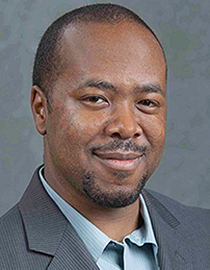
Bertrall Ross, professor of law
“This is perhaps the most consequential election for African Americans and people of color since the election of 1860, or at least since 1960 or 1964,” said Bertrall Ross, the Chancellor’s Professor of Law at the UC Berkeley School of Law. “What we’re seeing in the campaign now is the same voter suppression practices we have seen historically to target African Americans and other people of color. But this time, those who promote voter suppression will have the pandemic as both a justification for voter suppression practices and a tool to support the practices.”
Political scientist Eric Schickler, co-director of Berkeley’s Institute for Governmental Studies (IGS), said an “erosion of restraints” in a “racially polarized party system” has cleared the way for greater use of “stack-the-deck” strategies.
“You hear people talking openly about making it harder for groups to vote — whether it’s young voters or Black voters or Latinx voters — in a way that echoes the Jim Crow South,” Schickler said. “It’s really something we haven’t seen in recent American politics. It’s out in the open, explicit.”
Berkeley News will examine racial justice in America in a new series of stories.
Going back more than 50 years, Republican presidents Richard Nixon, Ronald Reagan and George H.W. Bush all sought to galvanize white votes with attacks on people of color — often, though, in subtly coded communication. This year, however, is different. Not only are the racial attacks explicit, as Ross and Schickler say, but they come at time when communities of color are particularly vulnerable to the COVID-19 pandemic and vulnerable, as well, to persistent episodes of police violence — often committed with impunity. And, they add, Republicans are attempting to use those vulnerabilities to their advantage.

While vote suppression targeting people of color is a grim tradition in U.S. elections, this year the election process itself has become a central campaign issue. Trump has warned repeatedly, and without evidence, of Democratic efforts to rig the vote, and the allegations implicitly justify vote suppression. Democrats fear that built-in bias in the Electoral College already puts them millions of votes in the hole, and that purged voter rolls, disinformation campaigns and long voting lines could literally cost them the election.
Already, that’s setting up a historic fight over the legitimacy of the election results. Berkeley political scientist Susan D. Hyde, a specialist in “democracy backsliding,” said these efforts raise fundamental questions about the health of America’s political system.
“The assault on the right to vote is always troubling,” Hyde said, “and it is definitely on my long list of worries for the 2020 U.S. election.”
A bias at the root of American democracy
“One person, one vote” — the idea is an expression of American democracy in its pure form. In practice, however, the effort to limit the political power of people of color, or to disenfranchise them altogether, dates to the founding of the nation.
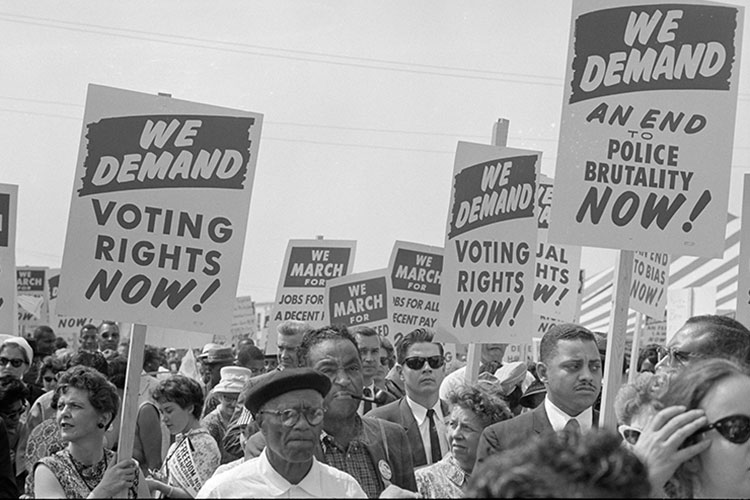

Only after the Civil War, with the passage of the 15th Amendment in 1870, were Black men given the right to vote. Not until the 19th Amendment passed in 1920 were Black women allowed to vote. Even then, a vast system of obstacles — including poll taxes and literacy tests — prevented many Black people from voting.
The civil rights movement focused on many of those practices, and the Voting Rights Act of 1965 had a profound effect on reducing vote suppression. Still, inequality persists.

Why? One cause is the bias hard-wired into American political institutions, Schickler said.
In recent practice, Republican-dominated states have gerrymandered congressional districts — manipulating the boundaries to assure that people of color are the minority in some districts or overwhelmingly concentrated in just a few districts.
The U.S. Senate is similarly unbalanced, with smaller rural states holding seats and influence far out of proportion to their populations.
The Electoral College, which ultimately determines the winner of presidential elections, has a similar bias. Consider California: In 2016, Democrat Hillary Clinton received nearly double Trump’s vote in the biggest U.S. state. But whether she won by 4 million votes or just 40, she would have gotten the same 55 electoral votes.
In Wisconsin, Michigan and Pennsylvania, she lost by a combined margin of less than 80,000 votes — but Trump got all of their electoral votes. In effect, Clinton’s surplus 4 million votes in California were wasted in the Electoral College.
In recent decades, as people with higher education, those with liberal values and people of color have become more and more concentrated in cities, the structural bias has only become stronger in favor of rural states that have smaller minority populations.
Today, the structural bias is so great that, in Schickler’s calculation, Democrats need to defeat Republicans by at least 3 to 4 percentage points in the popular vote to assure victory in the Electoral College. That means Biden may need up to 5 million more votes than Trump nationwide to eke out a win in the Electoral College.
A campaign based on stacking the deck
Republicans have won the popular vote in a presidential election only once since 1992 —with the re-election of George W. Bush in 2004. In 2000 and 2016, they lost the popular vote, but won in the Electoral College. They understand that America’s increasing diversity works against them, and increasingly, they’ve answered by trying to discourage or block voters in swing states with significant minority populations.
News reports this week showed that, in 2016, Republican candidate Trump used advanced data-driven techniques to target 3.5 million Black voters with social media messages aimed to discourage them from voting. Latinx, Asian American and other communities of color also were targeted.
“Republicans believe, correctly, in most cases, that minorities and young adults disproportionately support Democrats,” said Thomas Mann, an IGS resident scholar. “Reducing their turnout works to the advantage of Republicans.”
Driven by that incentive and enabled by key legal rulings, Republicans increasingly embrace what Schickler and other scholars call “deck-stacking strategies”:
Purging voter rolls. Election officials typically remove the names of people who have died or moved from rosters of registered voters. But some states go further, removing names of people who have not voted in recent elections — a practice that is prone to error and may be unconstitutional.
In recent years, the fight has been intense in three GOP-dominated battleground states. Georgia purged 1.4 million names. Ohio last year purged 460,000 registrations, thousands of them in error. A conservative group in Wisconsin this year is pressing for a new purge, with the case now pending in court.
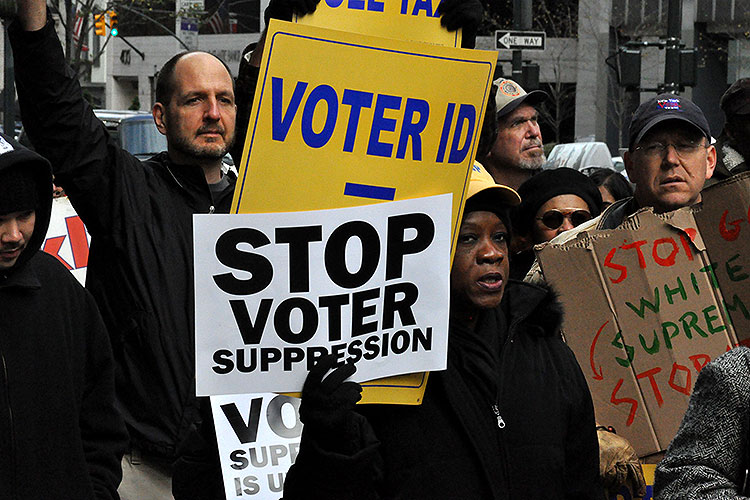

Voter ID Laws. Since 2000, at least 25 states have imposed new or stricter rules requiring voters to show identification at the polls. But Henry Brady, dean of the Goldman School of Public Policy at Berkeley, said an estimated 20 million or more voting-age Americans lack proper government identification, and most are people of color, young people or low-income people.
Barring felons from voting. Under Florida law, nearly a quarter of Black adults are barred from voting because of past felony convictions. In 2018, Florida voters approved, by a large majority, a measure allowing some 1.4 million felons to vote.
Republican lawmakers, backed by court decisions written by Republican-appointed judges, have largely blocked the Florida measure from going into effect.
How important are those votes? In 2000, George W. Bush took Florida — and the White House — with a margin of 537 votes. The state is expected to be close this year, too.
Using the pandemic to reduce voting
The emergence of the coronavirus pandemic in early 2020 fundamentally changed the presidential campaign, transforming the logistical challenges of safe voting into a core issue of the race.
While Democrats argue that voting by mail can help to keep voters safe, Republicans have argued — without evidence — that voting by mail raises the serious risk of vote fraud.
Underlying the strategy is a calculation: Fear of the pandemic will reduce the number of poll workers. If Republicans can reduce the number of polling stations and force people to wait in longer lines, research shows that overall voter turnout will be reduced. That’s likely to hurt cities more than rural areas and people of color more than white people — and Democrats more than Republicans.
The Wisconsin primary election last April is a case study. Milwaukee is the state’s biggest city, and people of color are a majority of the population. A shortage of poll workers forced the city to reduce its polling places from 182 in the 2016 general election to just five for the 2020 primary.
Absentee voting surged, but with the closure of polling places, overall turnout fell by about 8.5 percentage points from turnout in the 2016 primary — and by 10.2% among Black voters, according to a study by the non-partisan Brennan Center for Justice, a think tank based in Washington, D.C.
This fall, in a climate of confusion and fear, communities of color may be vulnerable.
“Since information about how and where to vote is surprisingly hard to come by,” Ross said, “misinformation campaigns can be quite effective in leading people to vote in a wrong way or at the wrong place. Even if voters realize that they’ve been scammed, they may not have the time, resources or the will to try to vote at the correct site.”
‘Massive electoral fraud and a rigged election’?
President Trump and other Republican leaders have waged an unrelenting attack on mail-in voting, contending — without evidence — that it favors Democrats. “Mail-In Ballots will lead to massive electoral fraud and a rigged 2020 Election,” Trump charged recently in a tweet.
Certainly early voting and voting by mail could reduce the advantage Republicans see in reduced polling stations and longer lines. But as Trump attacks the mail, Brady sees another possible motive.
“It may be,” he said, that “Trump is simply more concerned with undercutting the legitimacy of the election than he is with anything else.”
Such scenarios, dismissed even six months ago, are now central to discussions about Nov. 3 and the days after. If Biden wins in a landslide, that may prevent a bitter fight over the validity of the outcome. But if the race is close, and Trump loses, many worry that this result could jeopardize a clear outcome and a peaceful transfer of power.
In that scenario, Ross sees Trump targeting Black communities and other communities of color with unfounded accusations of vote fraud, casting suspicion on their political leaders, their local postal stations — and their ballots. Trump did the same in 2016, falsely blaming undocumented immigrants for Clinton’s win in the popular vote.
“Underlying that will be an implicit assessment of whether they belong, whether they should have voice in these elections,” Ross predicted. “And given the white racial hostility that this particular president has stoked, having that be a part of the discussion is dangerous and threatening, and it could have long-term negative effects on the willingness of Black and brown people to assert their voting power.”
Can we build a better democracy?
Legal action is underway to overturn some GOP suppression initiatives. But with little more than a month until Election Day, Mann suggested, the best countermeasure is straightforward: To overcome vote suppression, people need to try to vote, in overwhelming numbers. They need to be aware of obstacles, including misinformation and potential harassment at polling stations. Political organizers need to help communities navigate a complex and threatening landscape.
If Democrats can win control of the White House, both houses of Congress and more states, Mann said, experts already have identified a range of measures to strengthen voting rights and elections.
For the long term, Mann suggests that mandatory voting laws would eliminate incentives for vote suppression. Schickler said Democrats could focus on statehood for Washington, D.C., and Puerto Rico, which could help offset the current built-in bias in Congress and the Electoral College.
Other experts suggest the answer to vote suppression has to include old-school political organizing — and recent experience in Arizona shows how effective that can be, said Berkeley Law professor Kathryn Abrams. A campaign to defeat controversial anti-immigration Maricopa County Sheriff Joe Arpaio in 2016 was part of a broader, sustained effort that increased Latinx turnout in the 2018 election to 49%, up from 32% in 2014, she said. The organizing over the course of a decade — even after Arpaio was defeated — helped to register 500,000 new voters.
And yet, this year’s racially divisive presidential campaign raises existential questions about the nation’s political future. One important question rests with the Republican Party, Schickler said. “Do they adapt to this multiracial democracy, or do they keep fighting it?” he asked. “The optimistic take is that, eventually, as demographics keep changing and counter-organizing continues, the strategy of suppression will lose its appeal.”
Ross is mulling that question, too, but he foresees the possibility of political crisis leading to civil conflict.
“One of the questions that we need to face over the next four years is, ‘Is this kind of multiracial democratic project going to work for the future?’, he said. “It’s a time in which it feels that we can take a step backward, in terms of civil rights gains that we’ve made over the past half-century.”