
Tempers flared at the NID board meeting after PG&E’s Strategic Agreement Consultant Seth Perez gave yet another reason for delays to repairs at Spaulding and characterized the repairs made so far as “a benefit for NID customers.”
Perez started out by saying the utility corporation was making adjustments and getting ready to test their alternative for Spaulding Powerhouse #2, which has been out of operation since late 2023.
During the October 9th NID meeting, directors were told by a different PG&E representative a bypass at Spaulding powerhouse #2 would be tested that week and if tests were successful, more water could be sent to Scotts Flat to alleviate that reservoir’s very low levels.
Director Ricki Heck asked about a report sent by PG&E to the Federal Regulatory Commission (FERC) the very next day. The publicly available cover letter states, in part, “Although PG&E successfully completed the work to safely return limited flows through the Spaulding No. 1 Powerhouse, additional work is required to release the project to full operation. Significant effort remains to replace the PRV B discharge horn and finish several lower priority tasks for final acceptance of the PRV A discharge horn. Additional work also remains to remove portions of the damaged concrete columns and protect the new columns and discharge chamber from long-term wear and deterioration.”
Heck pointed out that information was not shared with NID. “I just want to point out that doesn’t help build trust for us or the community when we are told one thing on the 9th and we see a memo on the 10th that seems to contradict what we were told.”
She also questioned why the memo to FERC stated additional work needed to be done when NID was told repeatedly that demolition work of the crumbled columns and the new, steel-cladded supporting columns were completed.
Perez “speculated” that possibly the PG&E representative at the October 9th “when he meant completion of the PRV A [one of the two discharge horns] and the wall, that was completion to return flows of water. So, we have some return work that we need to complete associated with the wall. We’re going to install … steel cladding to armor it against future flows when we return the unit to full service.”
However, as far back as July 10, various PG&E spokespeople assured the NID board and the public those repairs were complete:
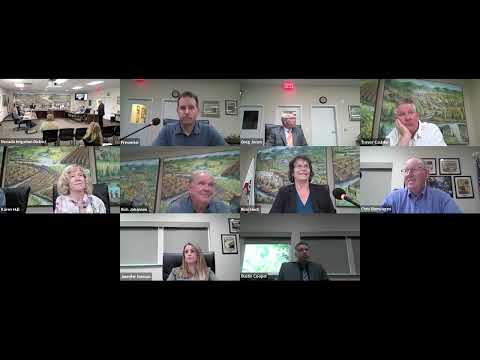
Directors want accurate information
Director Karen Hull went back to a previous point made by Director Heck and added, “It’s really unfortunate that the way the information is flowing is disjointed.” Referring to the October 10 memo sent to FERC, she said, “I don’t think [NID] management knew anything about it. There’s assumptions being made about what’s important to us and what’s important to you. We have a higher need to know than is being responded to.” Perez responded they would finish the additional work during the next outage when they replace the second discharge horn.
“So let me be clear,” Hull said. “We want to know about that. When it’s not complete, we want to know so we can do our part to communicate… We have to be involved and included when there is additional work that affects our customers’ perception about the system functioning with 100% completion.” Perez promised to add more info to the meetings they have with NID staff.
Director Chris Bierwagen concurred with Hull. “We’re the last to hear. Okay, staff hears it but we can’t talk about it until we have a board meeting. So now we’re another two weeks before we even get the information… It’s been my frustration all along with this whole project, not always knowing exactly what’s going on and what we can expect.”
Director Rich Johansen put it even more succinctly, “If you want a good partner in the community, treat us as one. Let us know with full disclosure what’s going on.”
GM cites concerning letter from PG&E to NID
General Manager Jennifer Hanson also had a couple questions. She asked again for a schedule of completion for the work done at Spaulding. Perez said they had a draft that is nearly final and he would get back with the team and “I’ll see what I can do.”
Hanson then asked about the status of the root cause analysis, stating back and forth correspondence between the two entities related to it. “So the root cause analysis is a utility practice that PG&E itself has identified when a major event goes on. Over the past several months, we’ve been told several times that PG&E would provide that root cause analysis so we can better understand what precipitated some of these events… We have four significant issues in one small area between Spaulding 1, Spaulding 2, the low-level outlet at the dam and then the pipe that fell off the hill. A number of you told me you would give it [root cause analysis] to us and then we were told at our last board meeting that we would not be receiving it. We wrote a letter, again requesting it and we received a letter dated October 21 that I find really concerning.”
She then cited a sentence in the letter: “Going forward, PG&E will provide additional information related to any subsequent repairs and documentation related to the cost of repairs, for which it will seek contribution from NID in accordance with the terms of the COA [Coordinated Operating Agreement].”
Hanson said NID received a letter indicating that PG&E was going to request some cost recovery from NID for the repair of PG&E’s own facilities. “Where we’re having a challenge is, if you don’t provide the root cause analysis, it’s difficult to ascertain whether or not that those cost sharing would be required under the COA. So, can you help us understand why you’re not providing the root cause analysis so that we can help make a determination under the legal parameters of the contract?”
Perez appeared somewhat flustered at that point, “I just want to clarify, it’s not a root cause that was filed with FERC, right? It was a failure analysis.” Hanson retorqued, “I haven’t seen it, so…”
Perez then pivoted to the cost share, “I think I just want to take a step back and talk about the sharing of this document, right, the request for the document and our subsequent response to deny that request… I think as we’ve been talking about this over the last few months, we’ve tried to frame the sharing of documents and information um through the perspective or the lens of the requirements of the COA… Our interpretation and what we’ve read there’s, there’s no requirement to share this information with NID and so you’re you’re requesting a document that you’re not entitled to under under the COA.”
Hanson pointed out that “now I’ve heard two different reasons why you’re not going to share the document. The first one was due to FERC security issues which frankly that designation is to prevent or help to prevent terrorism and I believe that we addressed that concern by signing and submitting to PG&E a non-disclosure agreement with our last request. I don’t think that it is unreasonable for NID to want to understand what occurred up at that facility.”
Referring back to the PG&E letter dated October 21, she cited another sentence that reads, “PG&E has honored and will continue to honor its requirements related to repairs to the Spalding facility, all of which have benefited NID and its constituents.” Hanson stated, “You know, it’s really difficult to accept that statement in any positive light when the failure of maintaining your facility and then subsequently having to repair it is now being framed in this letter as a benefit to our customers and to NID. This whole situation is going to be extremely costly for the district and our ratepayers, and I find it unfathomable that sentence was even included in this letter. Can you explain why anybody thought that was appropriate?”
Here is the exchange that followed:

But wait, there’s more
“PG&E expects NID will honor its contribution and obligations going forward,” was another line in the Oct. 21 letter from PG&E to NID. “What does that mean?” Hanson asked. Director Johansen remarked, “That’s kind of drawing a line in the sand that you may not want to cross.”
Hanson explained, “These types of letters, and refusal to provide information that enables us to understand and to convey to our customers and constituents what is going on, so they have a comfort level going into the next irrigation season… to receive this letter, I find it contrary to those beliefs of collaboration between the two entities and I’d like you to please inform your higher ups or whoever actually wrote this letter that we would like a conversation about it.”
Perez piped up, “I think going back to the obligations and I it goes back to the COA, right. So we’ve, from our perspective have honored our our requirements under the COA and I think we’re just trying to say that we and I think specifically around cost sharing for the project that we expect NID to do the same.”
Hanson countered, “I can tell you what our expectation from the COA is. It’s that PG&E maintains their facility to reasonable utility practices and I don’t believe that was done. Otherwise, you have just really bad luck having four issues happen at the same location at the same time.”
Director Hull thanked Hanson for her comment and said, “This is beyond ridiculous. You want us to pay, to have the repair that occured, we can assume, because of lack of maintenance and you won’t provide us with the failure analysis. You want us to just fork over money? Are you kidding? That is just not gonna happen… It’s beyond ridiculous.”
Director Heck stated that there had been some pushback from PG&E to attend these board meetings and asked board President Johansen if the board believed an appearance by PG&E at their next meeting was needed. Johansen said, “I was going to say, November 13.” Perez replied, “I can’t commit to PG&E being here until we have some substantive updates to provide around Spaulding [powerhouse] 2.” Johansen said, We already have some questions that are pretty weighty and we need answers.” Director Heck agreed, “One of them is when the testing on the bypass is going to actually occur. I thought it had happened that’s why I brought it up.” Perez ended his participation by restating that he couldn’t commit PG&E to attend the next NID board meeting.
The much-cited COA – a refresher
The Coordinated Operating Agreement (COA) cited frequently during this meeting pertains to a document signed in 2018 by a previous NID General Manager and a PG&E Vice President. It spelled out the ownership of various canals, reservoirs, powerhouses and other infrastructure owned by the two parties. It also codified operations and maintenance requirements, including water storage for the other entity in various reservoirs.
YubaNet obtained a copy of the COA by filing a public records act request in June of 2024.
The COA spells out the percentage of cost share under an extraordinary event. For example, PG&E can bill NID for 25% of the cost incurred for repairs to the Spaulding main tunnel.
The COA’s confidentiality clause reads, in part, “Subject to Section 8.18( d), the Receiving Party agrees to keep the Confidential Information received from the Disclosing Party hereunder in strict confidence and not disclose such Confidential Information to third parties ( excluding any parent, subsidiary and/or affiliate companies of the Receiving Party) and/or any other persons, except board members, employees, agents, consultants, and/or subcontractors of the Receiving Party with a “need to know’” (“Representatives”), and provided that such Representatives are bound by a materially similar obligation of confidentiality with respect to such Confidential Information as to which the Receiving Party is bound under this Agreement.”
In plain English, PG&E can share confidential information with NID staff and vice versa.
The full NID meeting is available on YouTube.
The next regular meeting of the NID Board of Directors will be held on November 13, 2024, starting at 9:00 am.


