
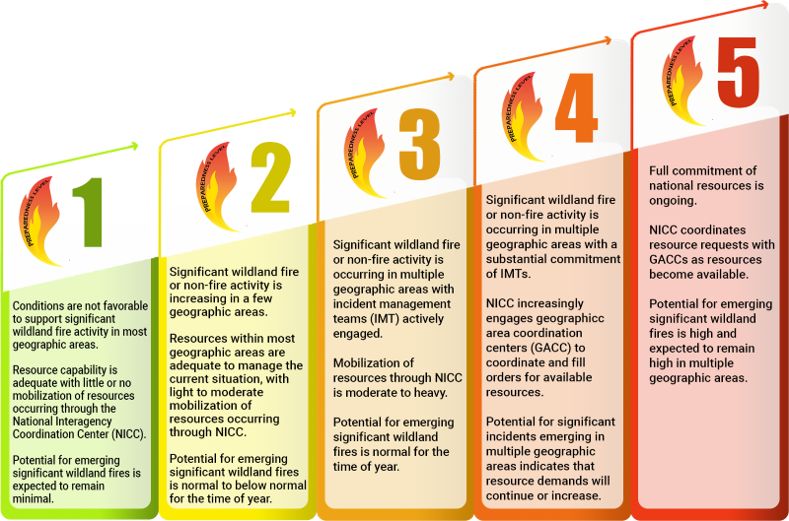
National Preparedness Level: 1 (On a scale from 1 to 5)
Northern California PL: 2
Southern California PL: 3
Smaller, local incidents are listed in the Happening Now section.
Current National Situation:
October 14, 2026 – Initial attack was light with 55 fires reported. 3 new large fires reported and 2 large fires contained.
| Nationwide yesterday | Year to date | 10-yr average |
| Fires: 55 Acres: 371 | Fires: 64,393 Acres: 9,032,816 | Fires: 48,642 Acres: 6,300,584 (2016 – 2025 as of today) |
| California | Year to date | 5-yr average |
| Fires: 6,062 Acres: 333,392 | Fires: 7,664 Acres: 1,091,247 |
Regional fires
| Incident Name | State | Lead Agency | Size (acres) | Percent Contained | Estimate of Containment | Personnel | Structures Destroyed |
| Chalk Fire | CA | TNF | 1 | 100% | October 14, 2026 | 40+ | 0 |
| Rock, Nevada City | CA | NEU | 2-3 | October 11, 2026 | 60+ | 0 |
California fires
| Incident Name | State | Lead Agency | Size (acres) | Percent Contained | Estimate of Containment | Personnel | Structures Destroyed |
| Norte | CA | OFCA | 570 | 5% | unknown | 6 | |
| Dome, Yosemite | CA | YNP | 6,829 | 61% | October 17, 2026 | 935 | 0 |
| Timber, Los Padres NF | CA | LPF | 25,350 | 97% | November 1, 2026 | 266 | 1 |
Out of state fires
| Incident Name | State | Lead Agency | Size (acres) | Percent Contained | Estimate of Containment | Personnel | Structures Destroyed |
| Hawk Fire, Nevada | NV | TMFX | 15,085 | 93% | September 1, 2026 | 570 | 48 |
Map information using data provided by the National Interagency Fire Center. The data is subject to change.
Weather Outlook
An upper-level low will slowly move eastward through the central Rockies today with widespread showers, falling as snow above 7,000 to 8,000 feet. To the east, a slow-moving cold front will continue to bring widespread showers and thunderstorms to the central Plains and Mid-Mississippi Valley today, with widespread showers and thunderstorms also expected in west Texas today as tropical moisture from Mexico and Pacific Hurricane Simon moves northward. A cold front will also move through the Northeast and Mid-Atlantic with light precipitation while the Southeast and Lower Mississippi Valley are dry. Dry weather is expected across most of the rest of the West, with above-normal temperatures expected across much of the West Coast. Light, but dry trade winds are expected in Hawai’i while cool temperatures and isolated snow showers are expected in Interior Alaska.