
Astudy conducted by UC Santa Barbara researchers and collaborators has found that California has lost more than half of its coastal dune systems. The researchers’ assessment — the first of its kind for the California coast — estimates that 60% of dune systems that existed from 1850 have been lost, due to a combination of urban development, land-use changes and erosion.
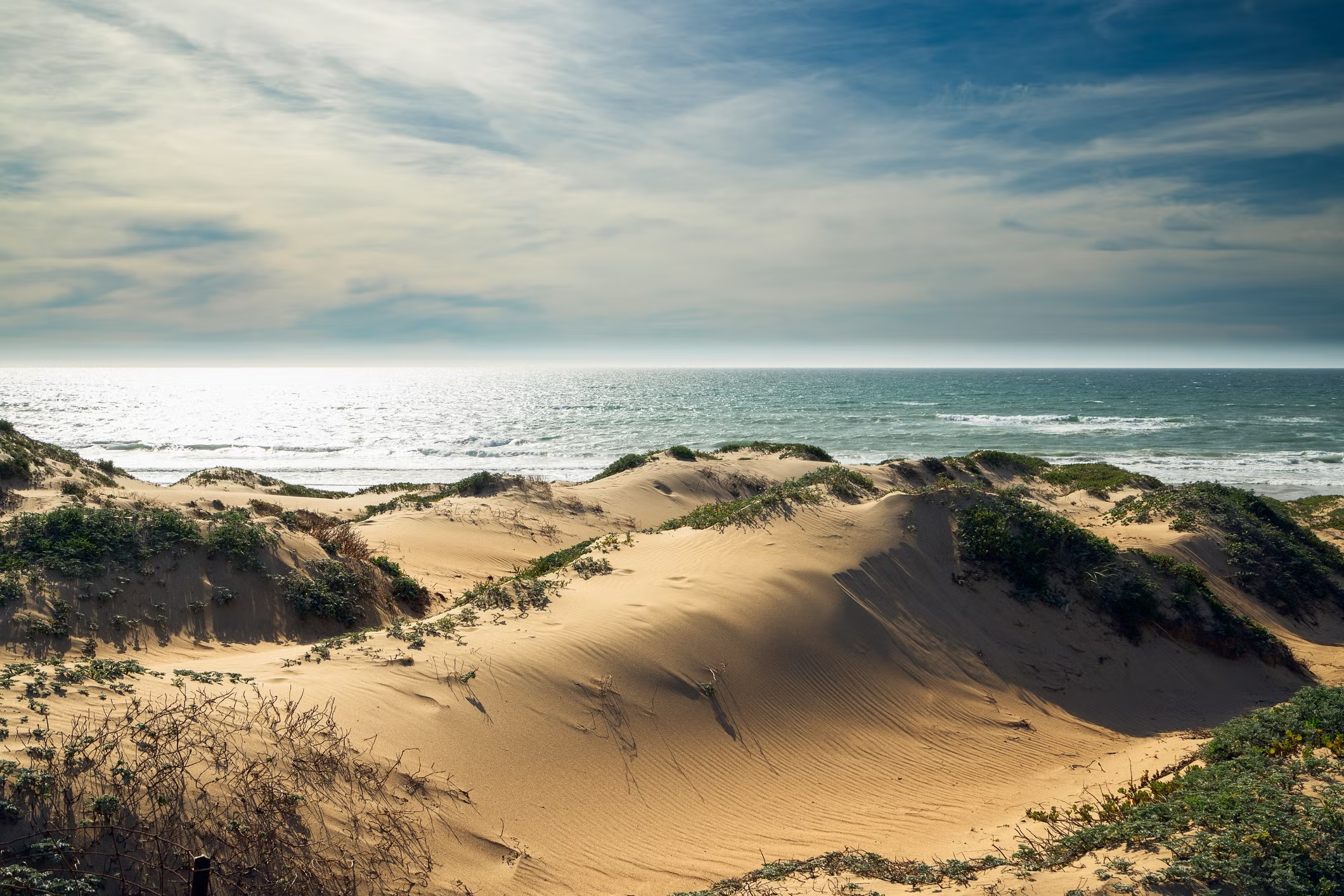
“There are major implications of this loss for the California coast, including reduced habitats for plants, insects and other invertebrates, birds and small mammals,” said the paper’s lead author, postdoctoral researcher and physical geographer Tim Baxter. “Importantly, we also lose coastal protections against storms and sea level rise.”
This assessment, one of the largest and most detailed inventories of coastal sand dunes ever produced, is published in the journal Earth’s Future.
California’s coastal dunes through time
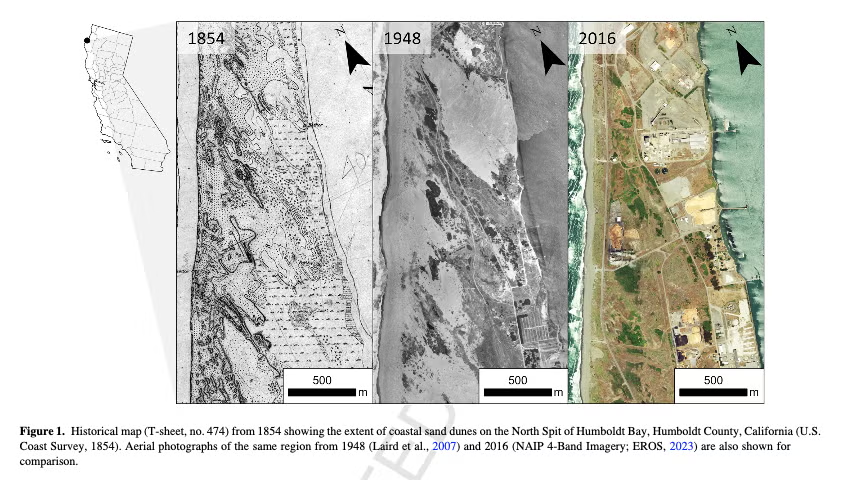
According to the study, around the time California emerged as the U.S.’s 31st state, it had about 739 km2 (about 285 square miles) of coastal dunes. After 165 years these dune fields, which capture and supply sand to nearby beaches, have dwindled in area to almost 300 km2 (about 116 square miles). That is mostly due to human activity, including migration and settlement, which started as early as the Gold Rush (1848), and subsequent development. While a small amount — roughly 18 km2 (seven square miles) — was lost through natural processes, including erosion at estuaries and rivermouths, the vast majority of dune loss is the result of human activity, including the development of roads and other infrastructure, agriculture and the introduction of invasive plants.
The biggest losses, according to the researchers, were in the areas of densest urban development.
“The thing that surprised me most was the scale of loss in San Francisco and Los Angeles,” said co-author Kyle Emery of UCSB’s Marine Science Institute. More than 95% (or 108 km2 or 42 square miles) of sand dunes that originally existed in those locations were removed to make room for roads, city infrastructure, housing and commercial buildings and other development. Meanwhile, Central California was also found to have lost 60% (331 km2 or about 128 square miles) of its coastal dunes. Approximately half of what’s left of California’s coastal dune systems are isolated — cut off from coastal processes by infrastructure and transportation networks. Through the study, the researchers also document some dune growth in southern California, including places where dune restoration is taking place.
As communities up and down the California coast contend with the fate of their shores amidst sea level rise, dune systems have become an attractive restoration option, providing sustainable, self-healing protections against the encroaching ocean.
However, sand dunes may not be the best solution for every shrinking beach. A variety of factors, including cost, space, location and the priorities of municipalities that are making their plans for sea level rise, will dictate whether dunes are an effective investment. This uncertainty, coupled with the highly diverse, dynamic environment of the California coast highlighted deficiencies in the understanding of these sand dunes. It also prompted the researchers to take on the challenge of characterizing these coastal landforms, the forces that make them and the places that could host them.
“Coastal sand dunes are really challenging to map,” Baxter said. “It required months of careful analysis using a variety of analytical methods — historical archive analysis, machine learning tools, site visits — and datasets, including historical maps, high resolution aerial photographs, and LiDAR.” In the process, the researchers could see the evolution of California’s coastal dune systems in a wide variety of settings and conditions through time.
The method, according to researchers, can be applied to other areas in the world that are contending with sea level rise, and are considering dune systems as a defense.
“Our methods provide a framework for assessing large-scale habitat change that could be extended to coasts around the world to aid identification and prioritization of suitable restoration sites, helping to offset past dune losses and mitigate future climate change impacts.”
This work was funded by the UC Office of the President Climate Action Research Initiative
Research in this paper was also conducted by Ian J. Walker (PI), Jenifer E. Dugan (PI), David M. Hubbard, Karina K. Johnston, Sarah Smith, Dakota R. Fee and Dan Willett at UCSB; Laura Engeman and Jenna Wisniewski at UC San Diego, Sean Vitousek at the U.S. Geological Survey Pacific Coastal and Marine Science Center, and Andrea J. Pickart at the U.S. Fish and Wildlife Service.