
NEVADA CITY, Calif. June 23, 2026 – A few tips on what to do when you see smoke. Residential burn piles are done for the season, climate change, herbaceous fuel loading, green-up across the high country and “snow crush” in the Sierra Foothills exacerbate fire danger in our area.

“Significant Fire Potential is projected to be near to above normal during June then trend above normal July through September across most areas with exception of near Coastal areas,” according to the NorthOps outlook. During July there is an average of 15 large fires while increasing to 17 during August then lowering to 8 during September.
An important rule: If you see flames or a huge smoke plume developing, call 911 before you call or text us!
Any plume of smoke is, of course, a cause for concern. But, what if you only smell smoke? Here are a few tips:
First, look around
If you smell smoke, first make sure you are safe. Check your location for any visible smoke or flames. Step outside, look around the immediate vicinity. Do you see flames or smoke billowing nearby? Leave the area and call 911. Report what you see, give a precise location i.e. street address and a cross street. Especially if you are calling from a cell phone, make sure you give the dispatcher your city and address. If you see a column of smoke or flames while driving and you don’t see first responders on scene, pull over to a safe area before calling.
Use common sense
During business hours, call your local fire department or CAL FIRE or the Forest Service if you are concerned about an unusual smoke buildup. Do not call 911 if you cannot see a column or flames, it could overwhelm the system and cause emergency calls to have a delayed response.
Also check Happening Now, in case there is a prescribed burn – these Rx fires are conducted by professional teams with special permits when conditions allow for fuel reduction operations to take place.
During fire season, smoke is often a part of daily life. In the early morning hours, only a faint odor and a light haze may be noticeable. As the day goes by, temperatures heat up and the trapped smoke will start to rise, intensifying the smell and reducing visibility.
At night, a breeze can have smoke waft into your house, apply the same rules as above. Look around you, step outside and assess the situation.
Firefighters will be dispatched to conduct a “smoke check” – therefore make sure you have as much information as possible. Especially on weekends, please check it’s not just your neighbor having a barbecue.
Avoid calls to the emergency services for updates on fires. The same goes for “where are the fire planes going?” Your local media is your best source for information – they are working in cooperation with the emergency services to get the word out.
Warming, cooking, and ceremonial fires are legal year round – as long as they are in designated fire ring/pit/BBQ type settings. Some exceptions apply in the South Yuba River canyon – fires on private property are prohibited until the end of declared fire season if no permanent water source is available. This applies mostly to unimproved parcels in the 1/4 mile corridor of the river – no water, no fire!
Fire services add the caveat that people are always responsible for any fire they light, legal or illegal. If a fire in a designated fire ring gets too big and ignites the surrounding area on fire, that person could be/will be held liable. Always check for fire restrictions if you are recreating on public lands!
Emergency dispatchers get 911 calls all summer long from people reporting their neighbors having a small warming fire in the backyard, in a designated fire pit. It’s perfectly legal.
Nevada County Alerts
Nevada County residents are encouraged to sign up as soon as possible for the County’s new emergency alert system, Nevada County Alerts, which is replacing the CodeRED notification system previously used for emergency alerts and evacuations. You can add multiple addresses (such as home, work, or family members’ locations) to receive alerts for each area.
The new Nevada County Alerts will come from up to five different phone numbers. This helps make sure alerts go out quickly, even when large volumes are sent at once. Residents are urged to add these phone numbers to their contacts to easily recognize an emergency alert:
- 530-394-6160
- 530-248-7554
- 530-248-7559
- 530-248-7564
- 530-385-0422
Residents can also register by calling 2-1-1 or 1-833-DIAL211 to receive assistance from a Connecting Point call agent.

Know Your Zone
In the event of a wildfire or an emergency situation, law enforcement and fire agencies issue evacuation warnings or evacuation orders for impacted areas called zones.
Authorities will use zone names in emergency alerts, media releases, and on social media to notify residents which areas are under an evacuation warning or order.
In order to understand whether your area is under an evacuation warning or order, you need to know and remember your zone name.
1. Go to https://protect.genasys.com/search
2. Enter your address into the search bar
3. Your zone will appear in the pop-up window

Hi-Lo Sirens
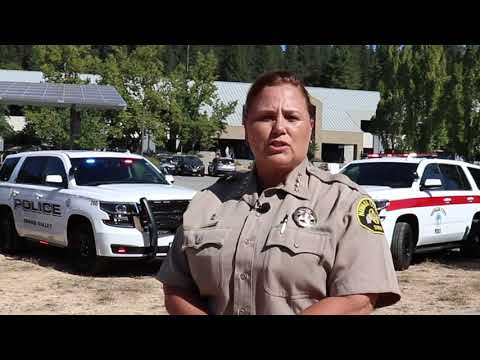
The Nevada County Sheriff, as well as the Grass Valley, Nevada City and Town of Truckee Police Departments, have all installed new sirens on their patrol cars and will only use them for evacuations. Familiarize yourself with the sound and immediately initiate you evacuation plan if you hear it. Nevada County Sheriff’s Office have created a video to help prepare you and your family.
Better safe than sorry
If you smell a strong “electrical” smell in your home, be aware of the possibility of wires shorting out and causing a fire, call 911.
If you notice power lines on the ground, never touch them as they could be energized. Call 911 and let the dispatcher know that power lines are on the ground. Firefighters need to know this information to be able to protect you and themselves from electrocution – and the utility company needs to be notified by dispatchers.
Once you have alerted the emergency services, you can always email news@yubanet.com, call 530-478-9600 or text 530-409-9888 to let us know too.
All large fires are constantly updated in our Fire News section and smaller, local incidents will be listed in the Happening Now running log.
For an explanation of commonly used fire terms, check out the Fire Talk post.
Contact information for Nevada County fire departments
CAL FIRE
Readyforwildfire.org
(530) 823-4904
Grass Valley/Nevada City Fire Department
grassvalleyfire.com
(530) 274-4370
Higgins Fire Protection District
higginsfire.org
(530) 269-2488
Nevada County Consolidated Fire District
nccfire.com
(530) 265-4431
North San Juan Fire Protection District
nsjfire.org
(530) 292-9159
Ophir Hill Fire District
Ophirhillfire.org
(530) 273-8351
Peardale Chicago Park Fire Protection District
pcpfire.com
(530) 273-2503
Penn Valley/Rough and Ready Fire Protection District
pennvalleyfire.com
(530) 432-2630
Tahoe National Forest
fs.usda.gov/tahoe
(530) 265-4531
Truckee Fire Protection District
Truckeefire.org
(530) 582-7850
Washington Fire & Rescue
(530) 265-4720
PS: Your Go bag is ready and you have a plan in case of a fire, right? Now that you are prepared, look at what you accomplished. If a fire were to force you to evacuate, you are ready and can focus on executing the plan. Your plan also helps first responders. If you are prepared and leave when asked they can focus on fighting the fire and keeping your neighborhood safe.
Communities in this area are generous and willing to help before, during and after disasters. Helping others is a great way to refocus your energy from fretting about hypotheticals to being an integral part of the community and making it a better place. It can be as small or big as you’d like. Ask a neighbor if they “Know your Zone” and show them how to find their zone. Volunteer for a charity, school or non-profit, join your local Firewise community.
Also, give yourself a break. It’s OK to step away from doom scrolling on social media or obsessively refreshing a webpage. Taking care of yourself puts you in a better position to act when needed and make sure you and your loved ones are safe. Just like having a full tank of gas in your car on a Red Flag Day, being informed, rested and ready mentally gives you a head start.