
As a strong El Niño forms in the Pacific, Nevada Irrigation District (NID) water managers are keeping a close eye on more than rainfall. This winter, the real story may be written in the Sierra snowpack.

El Niño is a recurring climate pattern that alters ocean temperatures in the tropical Pacific and can influence winter weather across the West. The National Oceanic and Atmospheric Administration (NOAA) now forecasts a greater than 90 percent chance of a very strong El Niño through fall and winter. But while El Niño often shapes storm patterns, its impacts are far from guaranteed. And in the Sierra Nevada, a wet winter doesn’t automatically translate to a robust water supply next summer.
Recent analysis from the UC Berkeley Central Sierra Snow Lab underscores that complexity. The Snow Lab examined snowfall totals during nine strong or very strong El Niño seasons dating back to 1950. The results were mixed: four seasons saw above‑median snowfall, three were below median, and two were roughly average. When isolating very strong El Niño years, snowfall tended to fall in the average‑to‑above‑average range, but not reliably so. For NID, that means a strong El Niño may increase the chances of solid snowfall, yet it doesn’t remove the risk of warmer storms and higher snow levels.
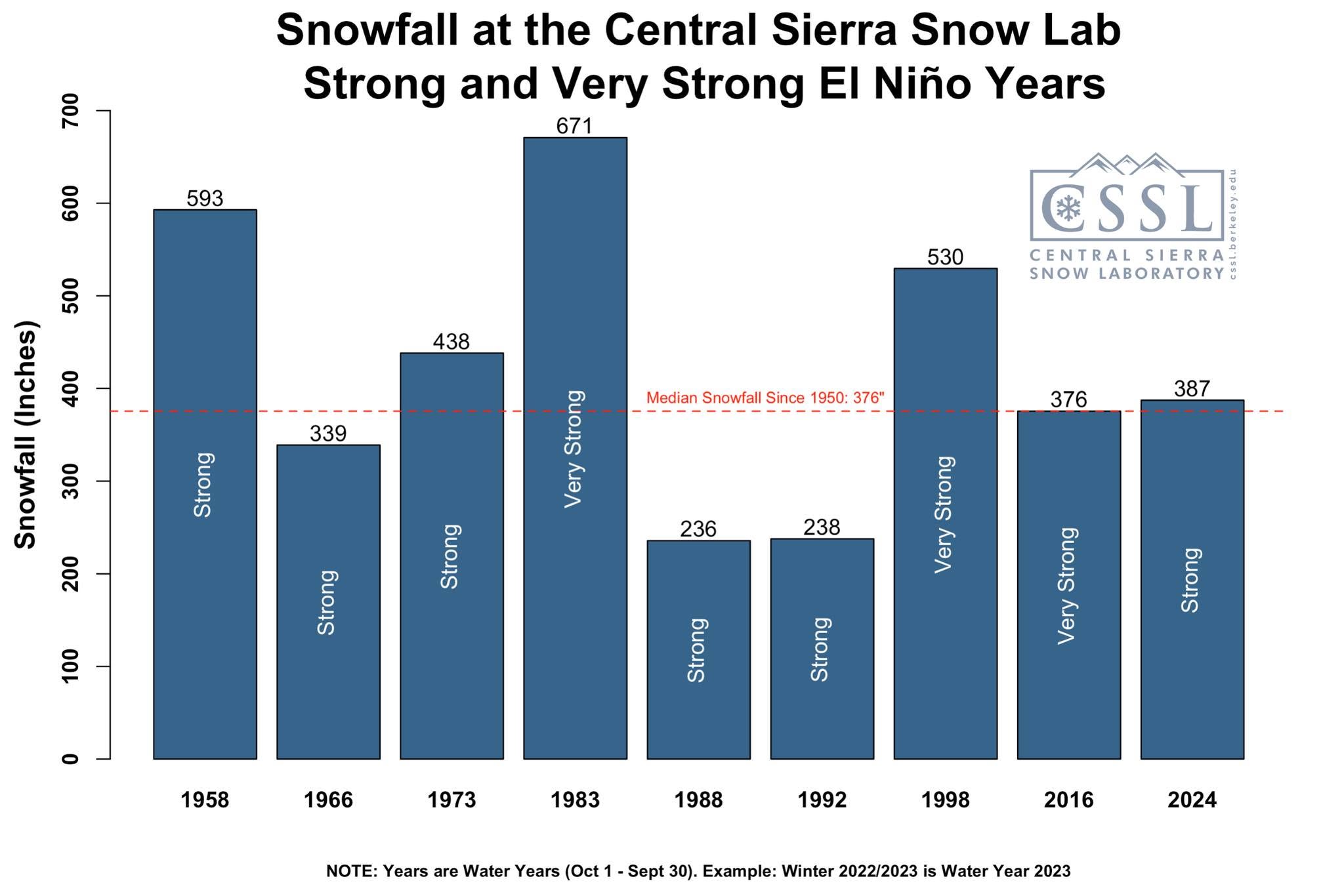
A full reservoir isn’t the full story
A full reservoir only tells part of the story. The missing piece is snow. Snowpack acts as the Sierra’s natural reservoir, storing water in frozen form and releasing it gradually as spring temperatures rise.
This year, that distinction matters. El Niño winters can push the Pacific jet stream south, bringing more storms to the central and southern Sierra. But those storms may be warmer, delivering rain at elevations that typically see snow. Atmospheric rivers can push snow levels thousands of feet higher, producing heavy rain below and limited accumulation above.
For NID, the key questions aren’t just how much precipitation arrives, but where it falls, what form it takes and how much stays stored as snow.
“When we look at the water supply, we’re looking beyond the next storm,” said Thor Larsen, NID Water Resources Superintendent. “We need to understand how much water is being stored in the snowpack and how that storage will carry us into spring and summer.”
The Sierra’s frozen reservoir
NID relies on snowmelt from a roughly 70,000‑acre high‑elevation watershed across the Yuba River, Bear River and Deer Creek. Without groundwater aquifers or higher‑elevation backup sources, the District depends on snow to refill reservoirs as spring arrives.

Snowpack acts like a reservoir without a dam. Rain can run off quickly, but snow holds water until temperatures rise. That’s where elevation comes in. NID’s highest reservoirs —French Lake (6,660 feet), Jackson Lake (6,592 feet), Faucherie Lake (6,123 feet) and Jackson Meadows (6,036 feet) — sit below elevations where snow may persist during warm storms. Under warmer winter conditions, consistent snowfall may only occur above 7,000 to 8,000 feet.

“When snow levels rise, we’re watching how rain affects the existing snowpack and how much is being stored as snow at the higher elevations,” Larsen said.
When rain looks like good news
Picture an NID reservoir in March: water levels high, inflows strong, outlook seemingly bright. But managers may be asking a different question: how much water remains stored in the mountains?
If warm storms deliver rain but little snow, reservoirs can fill quickly. But once storms end, less snowpack means less gradual runoff during spring and early summer. High reservoir levels in late winter can coexist with concerns about the water supply later in the year.
“A full reservoir tells us how much water we have today. The snowpack helps tell us what we may have available tomorrow,” Larsen said.
That’s why NID monitors snowpack, reservoir storage, inflows, weather patterns and runoff throughout the winter.
Conservation doesn’t take a winter off
There’s another part of the water supply equation that doesn’t depend on the weather: customers.
When rain is falling and reservoirs are filling, conservation can feel unnecessary. But if a wet winter produces less snowpack than expected, the water supply may become more challenging later in the year.
Using water wisely year-round helps stretch the supply NID has available.
Customers can help by turning off irrigation when winter rain provides enough moisture, fixing leaks promptly, checking irrigation systems for broken heads and overspray, and using water-efficient fixtures and appliances.
Watching the mountains

This winter will bring its own mix of storms. It means some warm, some cold, some snowy, some rainy. Snow levels will rise and fall. And while a rainy season is welcome, NID’s water story will depend on more than rainfall totals.
A full reservoir is good news. But the true measure of the Sierra’s water supply is written higher up, in the frozen storage of the mountains.
This article appears in NID.
